

Your Desk Isn't the Problem. Your Setup Is.
Every October, National Ergonomics Month rolls around, and with it comes the same wave of advice: buy a standing desk, buy an ergonomic chair, overhaul the whole office. Here's the thing. Most back and neck pain at a desk isn't caused by the furniture. It's caused by three small, fixable habits: a monitor sitting too low, a keyboard forcing your wrists into a bad angle, and a chair that's set up wrong for your body. Fix those three things, and you fix most of the discomfort, no new desk required.
This month is the perfect time to actually do it. Give yourself fifteen minutes and work through the fixes below in order. They build on each other, and by the end, you'll have a setup that holds up for a full eight-hour day.
Fix #1: Get Your Monitor to Eye Level
If you're looking down at your screen, your neck is working overtime. That forward head tilt, even a small one, adds real strain to your neck and upper back over the course of a day, and it compounds fast if you're staring at a laptop propped flat on the desk.
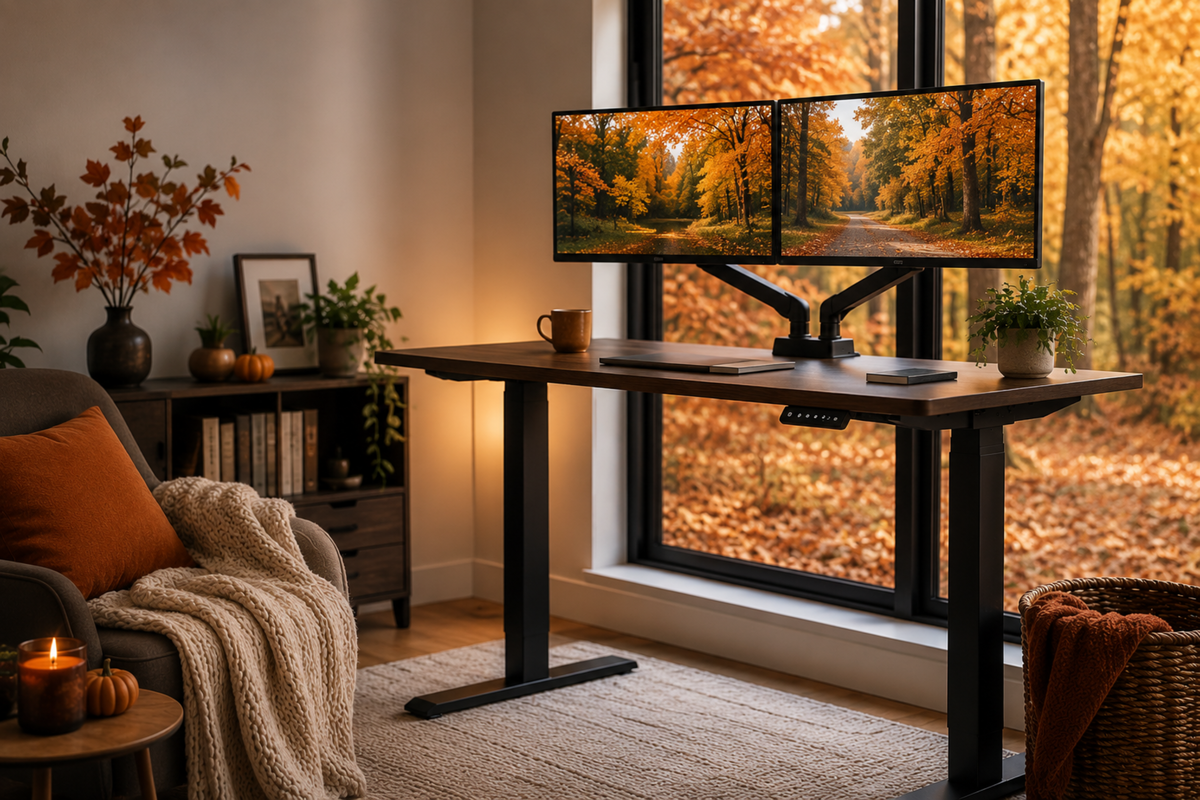
The fix is simple: the top third of your screen should sit at or just below eye level, and the screen should be far enough away that you're not leaning in to read it. A laptop stand gets you part of the way there, but a monitor arm is what actually solves it, because it lets you adjust height, tilt, and distance on the fly instead of stacking books under a screen and hoping for the best.
Fix #2: Stop Bending Your Wrists
Wrist strain is one of those things that builds slowly and then shows up all at once. If your keyboard sits directly on the desk, your wrists are probably angled upward while you type, which puts pressure on the same tendons that lead to repetitive strain issues down the line.
The goal is a neutral wrist position: forearms roughly parallel to the floor, wrists straight, not bent up or down. A keyboard tray that sits below standard desk height solves this without requiring a new desk at all. It also frees up surface space, which is a nice secondary win if your desk has turned into a catch-all for everything.
Fix #3: Fix Your Chair Before You Blame Your Back
A lot of desk pain gets blamed on "sitting too much" when the real issue is sitting wrong. Most chairs are adjustable in more ways than people actually use or know. Seat height should let your feet rest flat on the floor with your knees at roughly a 90-degree angle. Lumbar support should sit right at the small of your back, not somewhere above or below it. And armrests, if you have them, should support your elbows without forcing your shoulders up toward your ears.
None of this requires a new chair. It requires ten minutes of actually adjusting the one you already have, and most people have never done it since the day they unboxed it.
The Fifteen-Minute Fix List
Set aside fifteen minutes this week and work through it in this order: raise your monitor to eye level, drop your keyboard to a neutral wrist position, then adjust your chair height and lumbar support. Small changes, done in the right order, add up to a setup that actually supports a full workday instead of fighting against it. National Ergonomics Month is as good a reason as any to finally do it.

Share:
Sweater Weather and Standing Desks: Why Fall Is the Perfect Time to Build Better Habits